







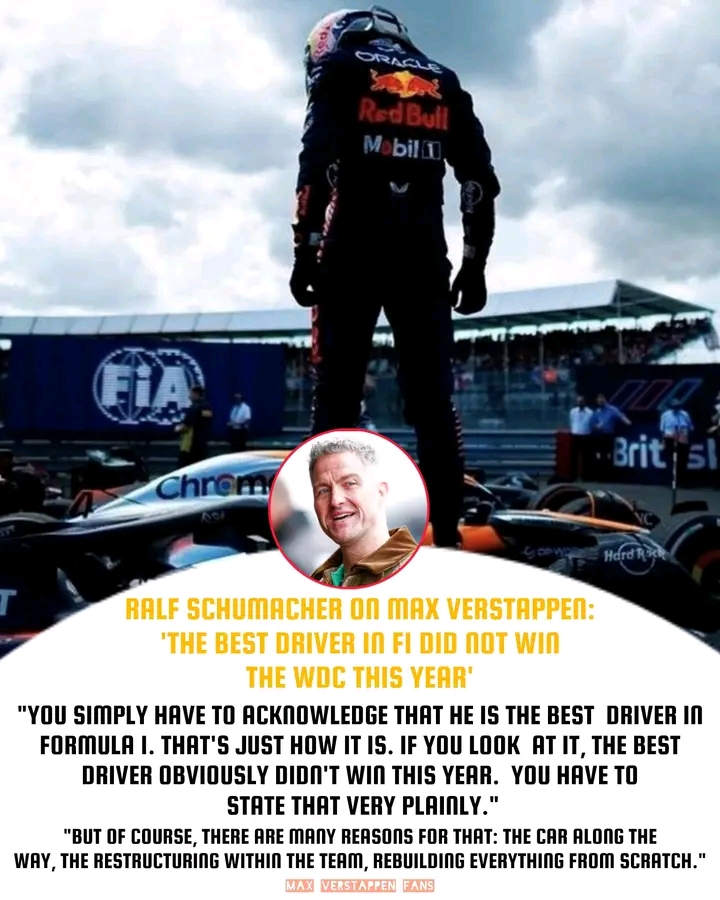
Ralf Schumacher on Max Verstappen: “The best driver in F1 did not win the WDC this year”
In the aftermath of one of the most turbulent and tightly contested Formula 1 seasons in recent memory, former F1 driver and television pundit Ralf Schumacher ignited debate with a pointed assessment of the championship outcome.
Speaking shortly after the final race, Schumacher declared that “the best driver in F1 did not win the World Drivers’ Championship this year,” a remark that has quickly spread through the paddock and fan communities alike. Though he did not explicitly name Max Verstappen, the implication was clear—and controversial.
Schumacher, known for his candid analysis and willingness to critique even the sport’s biggest stars, argued that Verstappen’s performance level remained unmatched despite the championship slipping away. “Week after week, Max showed an ability to extract results from situations where others would have settled,” he suggested.
“There were races where he carried the car, carried the strategy, and delivered something extraordinary. That’s what defines the best driver—not just the points tally.”
His comments arrive at the end of a season in which Verstappen faced stiffer competition than at any point during his recent dominance. With rivals capitalizing on improved machinery and more effective strategic execution, the margin for error narrowed dramatically.
Verstappen still managed several standout victories, displaying the same aggression, precision, and composure that have characterized his rise to the top of the sport. Yet a combination of reliability issues, strategic missteps, and occasional misfortune undermined his title defense.
For Schumacher, these setbacks do not diminish Verstappen’s individual brilliance. Instead, he claims they reinforce how dependent even the most exceptional drivers are on the broader team ecosystem. “F1 has never been solely about the driver,” he explained.
“But if you isolate the performances—look purely at speed, decision-making, consistency, and racecraft—Max was still the reference point. Championships don’t always reflect that.”
Unsurprisingly, Schumacher’s remarks have split opinion. Verstappen loyalists embraced his comments as validation, arguing that the Dutchman’s raw talent remains unmatched. Critics, however, view the statement as dismissive of the newly crowned champion’s achievements.
They note that championships reward not just speed but also execution, adaptability, teamwork, and reliability across an entire season. To them, the title winner earned the crown precisely by excelling in those areas.
The debate highlights a fundamental tension in Formula 1: the distinction between “best driver” and “championship winner.” They often align, but not always. This season may be remembered as one of those exceptions—a year where Verstappen delivered world-class performances yet fell short in the standings.
As the sport looks ahead, Schumacher’s comments add fuel to what promises to be an even more intense fight next season. Whether or not fans agree with him, one thing is certain: Formula 1 thrives on rivalries, narratives, and disputes, and this one is far from over.